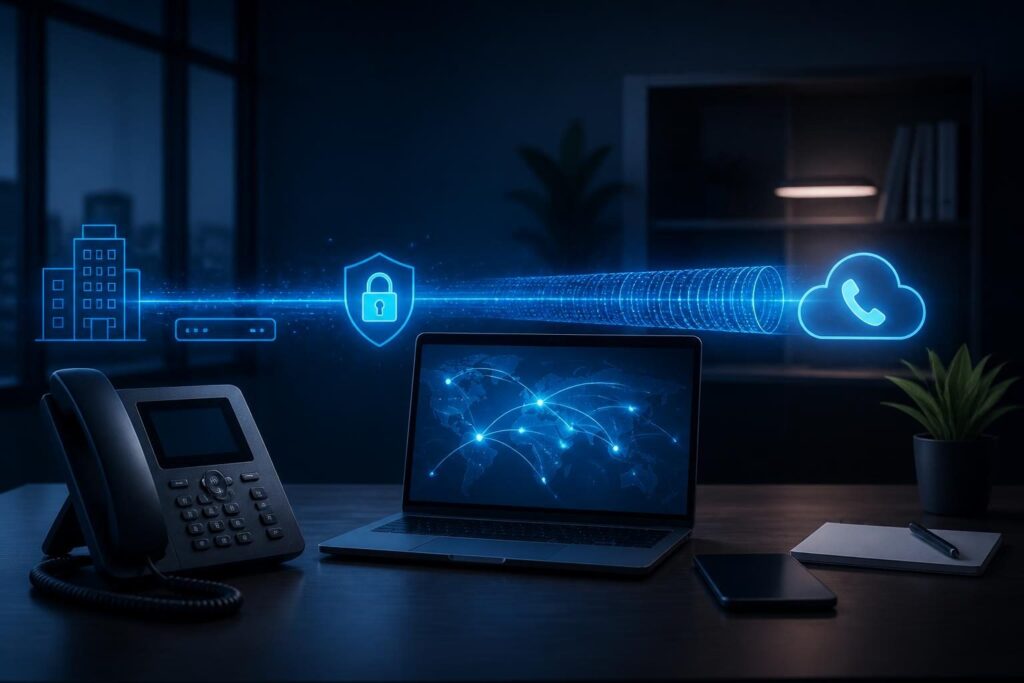
VPN VoIP audio problems often appear after a business adds encrypted remote access, changes a router, or moves phones between networks. The call may connect, yet audio becomes choppy, delayed, silent, or unreliable.
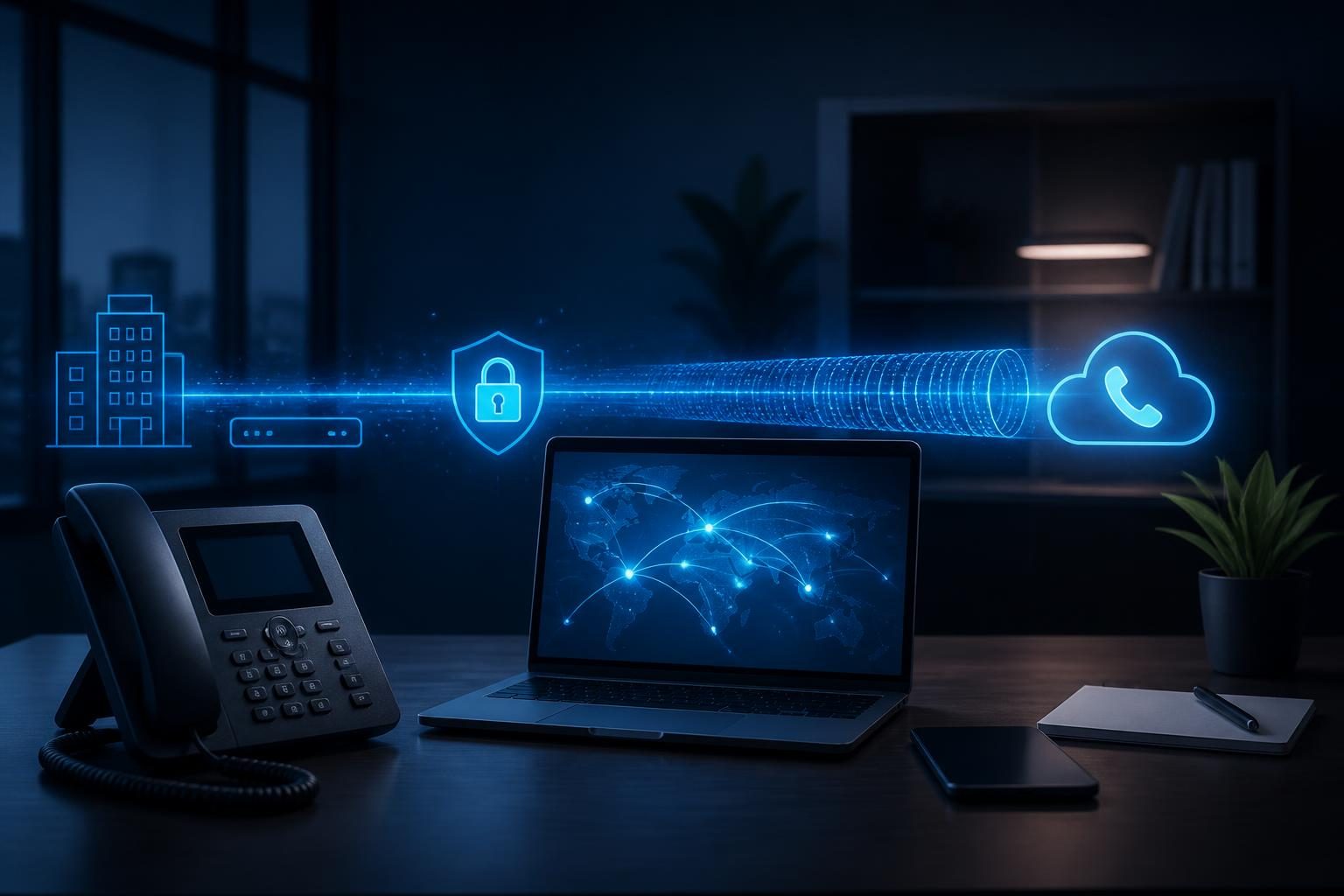
The VPN may not be “breaking VoIP” by itself. More often, it changes which network interface sends traffic, which route the system selects, or how the phone system sees each endpoint. That distinction makes VPN VoIP audio problems easier to isolate. A careful diagnosis separates signaling from media and tests one change at a time.
Why a VPN changes the voice path
A VPN creates an encrypted tunnel between networks or devices. Your computer or phone usually gains a virtual network interface, such as a tunnel adapter. That interface can add new routes to the operating system’s routing table.
A route tells a device where to send traffic. Before the VPN connects, a softphone may send SIP and RTP through the normal local gateway. After connection, the same traffic may use the VPN interface instead.
SIP handles call setup, including registration and dialing. RTP carries the actual audio. These two traffic types can follow different paths. Therefore, a call can ring and connect while its audio takes an unusable route.
VPN VoIP audio problems become easier to understand when you map both paths. Record the caller’s network, the PBX address, the phone’s address, and the expected direction of each media stream.
Interface selection matters
A device can have several interfaces at once. Common examples include Wi-Fi, Ethernet, a VPN adapter, a virtual machine adapter, and a mobile hotspot connection.
The operating system chooses an interface using route specificity and route metrics. A more specific route generally wins. If routes are equally specific, the system may prefer the route with the lower metric. VPN software can add or modify these values.
Check the active interface before changing settings. On Windows, inspect ipconfig and route print. On Linux, use ip addr and ip route. These commands display useful evidence, but interpret the results carefully. Do not delete routes unless you understand the effect on local access and remote administration.
Routes and split tunneling can create conflicting paths
Full tunneling sends most or all device traffic through the VPN. Split tunneling sends only selected networks through it and leaves other traffic on the normal internet connection.
Neither design is automatically correct for voice. The right choice depends on where the PBX, phones, SIP provider, and security controls are located.
- An internal PBX may require a route to the office network through the tunnel.
- A public SIP provider may not benefit from sending media through the VPN, especially when that adds delay or another NAT boundary.
- A softphone may reach SIP through the tunnel but send RTP through the local gateway, causing signaling and media to disagree.
- Two VPN clients with overlapping private networks may send traffic to the wrong destination.
For background, see Cloudflare’s explanation of VPN tunneling and routing. The goal is not to select a popular VPN mode. The goal is to make the intended voice path predictable.
Write down the expected path before testing. For example: “The laptop reaches the PBX through the tunnel, while the PBX sends RTP to the laptop’s VPN address.” Then verify whether the actual routes support that plan.
RTP paths are the main audio clue
RTP is the protocol that usually carries live voice. Unlike SIP signaling, RTP uses a range of UDP ports. The exact range depends on the PBX and its configuration.
Audio can fail when a firewall permits SIP but blocks, rewrites, or misroutes RTP. NAT, or network address translation, can also replace private addresses with public ones. That process becomes difficult when a VPN adds another address layer.
Common patterns include:
- No audio in either direction: RTP may be blocked, sent to the wrong interface, or advertised with an unreachable address.
- Audio in one direction: one endpoint can send media, but the return path cannot reach it.
- Choppy audio: packets may arrive late, out of order, or with variable delay.
- Audio that starts and then stops: a firewall timeout, route change, or tunnel policy may interrupt the media flow.
RTP does not usually need the same path as SIP. Look for the addresses and ports exchanged during call setup, then compare them with packet captures or PBX logs. Avoid exposing a capture publicly because it may contain addresses, call details, or other sensitive information.
For a broader explanation of media paths, review our guide to RTP and VoIP audio diagnosis. That article covers related NAT and firewall checks without assuming that a VPN is the cause.
MTU and fragmentation can damage call quality
MTU, or maximum transmission unit, is the largest packet size a link can carry without fragmentation. VPN encryption adds packet overhead. As a result, a packet that fits on the normal network may exceed the tunnel’s usable size.
Large packets may fragment, get dropped, or trigger path-related problems. Voice packets are usually small, but signaling, encryption overhead, and other network traffic can still expose an MTU mismatch.
Symptoms may include delayed registration, failed calls, intermittent audio, or quality that changes when the VPN is active. Test from the affected path rather than from a different computer on the same office network.
VPN VoIP audio problems can sometimes reflect an MTU mismatch, but do not lower MTU blindly. First identify the VPN technology, the endpoint operating system, and the network path. A technician may test packet sizes with a platform-appropriate command and adjust the tunnel or interface only after confirming the result.
A safe way to isolate the cause
Good troubleshooting compares conditions. It does not rely on repeated reboots or several configuration changes at once. Use one test call, one known location, and one controlled variable whenever possible.
- Capture a precise example. Record the time, caller, recipient, direction, device, VPN status, and symptom. Note whether the call connected.
- Test without the VPN. If policy permits, place the same call with the tunnel disconnected. This comparison does not prove the VPN is at fault, but it creates a useful baseline.
- Test with the VPN connected. Repeat from the same network and device. Compare delay, audio direction, and call duration.
- Check interface addresses. Identify the local, VPN, PBX, and remote service addresses. Confirm that the softphone advertises an address the PBX can reach.
- Inspect routes. Verify which interface handles the PBX network and the SIP provider’s network. Look for overlapping private ranges.
- Review firewall policy. Confirm that the relevant RTP UDP range is allowed in the intended direction. Check both endpoint and perimeter firewalls.
- Check packet evidence. Use PBX logs, endpoint diagnostics, or a controlled packet capture. Look for RTP packets leaving, arriving, and returning.
- Test MTU only after routing checks. A packet-size problem should match the observed path and symptoms.
Structured troubleshooting guidance from Google SRE supports this approach: gather evidence, form a specific hypothesis, and test it safely.
Configuration choices that deserve review
VPN and phone settings must agree about network boundaries. Review the PBX’s local networks, external address, NAT behavior, and media settings. If the PBX uses a VPN address for one call and a public address for another, investigate why.
Also review softphone behavior. Some applications bind to a selected interface. Others rely on operating-system routes. A VPN client may include an option that blocks local traffic, forces DNS through the tunnel, or prevents access to local networks.
Codec selection can affect bandwidth and processing, but it should not be the first explanation for a route-specific audio failure. Change codecs only after confirming that the media path works.
Finally, document the intended design. Include VPN subnets, office subnets, PBX addresses, RTP port ranges, firewall rules, and exceptions. This record helps prevent a later VPN change from creating a mystery outage.
When professional help is appropriate
VPN VoIP audio problems often require evidence from several systems: the endpoint, VPN gateway, router, firewall, PBX, and provider. If calls affect customers, avoid trial-and-error changes during business hours.
Tech Rescue Ops LLC can help trace interfaces, routes, RTP behavior, firewall policy, and MTU symptoms remotely. Start with a few timestamped calls and a clear comparison between VPN-connected and disconnected tests.
For related checks, our VoIP troubleshooting checklist can help organize the information before escalation.